
Wikipedia Agency vs. Freelancer: The Risk Nobody Warns You About
February 12, 2026
AI Reputation Management: Tools, Costs & Strategy (2026)
March 16, 2026
The best online reputation management companies for 2026 are Reputn, Erase.com, ReputationDefender, Status Labs, NetReputation, BrandYourself, Reputation Rhino, WebiMax, Thrive, and NP Digital. We reviewed dozens of firms based on service depth, content removal capabilities, client discretion, and real results to build this ranking.
Here’s why that list matters right now. Your online reputation gets formed before anyone meets you, calls you, or clicks your website. It happens the moment someone types your name into Google.
And you can’t always control what shows up. A bad review, a misleading article, an outdated mugshot, or a disgruntled competitor’s Reddit post can sit at the top of your search results for years. With AI overviews now summarizing search results, negative content gets amplified faster than ever.
The right reputation management firm can remove harmful content, push down negative results, build your authority through digital PR, and protect your name long after the initial cleanup is done.
But picking the wrong firm? That’s an expensive mistake. Some rely on shady tactics that backfire. Others lock you into long contracts with zero accountability.
How We Ranked These Companies
Before jumping into the list, here’s what we looked at. Not all reputation management companies are created equal, and surface-level comparisons don’t cut it.
Service range. Does the company handle everything from content removal to digital PR to ongoing monitoring? Or do they specialize in just one area and outsource the rest?
Content removal success. Can they actually get negative articles, reviews, and search results removed? Or do they just “suppress” results and hope for the best?
Client privacy. Reputation work is sensitive. We prioritized firms with strong NDAs, discreet billing, and a track record of handling high-profile cases without leaks.
Experience and track record. How long have they been doing this? How many clients have they served? Do they have verifiable case studies?
Pricing transparency. Do they explain how pricing works, or do they dodge the question until you’re on a sales call?
Digital PR and authority building. The best firms don’t just remove bad content. They replace it with positive, authoritative content that dominates search results.
Quick Comparison Table
| Company | Best For | Content Removal | Digital PR | Wikipedia Services | Starting Price |
|---|---|---|---|---|---|
| Reputn | Full-service reputation repair and privacy | Yes | In-house team | Expert-level | Custom quote |
| Erase.com | Pay-for-results content removal | Yes | Limited | No | Custom quote |
| ReputationDefender | Enterprise and executive protection | Yes | Yes | No | ~$5,000/mo |
| Status Labs | C-suite and public figure ORM | Yes | Yes | No | Custom quote |
| NetReputation | Affordable personal reputation repair | Yes | Limited | No | ~$1,500/mo |
| BrandYourself | DIY reputation monitoring + managed services | Limited | Limited | No | $399/mo (DIY) |
| Reputation Rhino | Small business and individual ORM | Yes | Yes | No | Custom quote |
| WebiMax | ORM bundled with digital marketing | Limited | Yes | No | Custom quote |
| Thrive Agency | ORM as part of full digital marketing | Limited | Yes | No | ~$1,000/mo |
| NP Digital | SEO-driven reputation strategy | Suppression only | Yes | No | Custom quote |
1. Reputn — Best Overall Reputation Management Company
Website: reputn.com
Best for: Individuals, executives, brands, and public figures who need complete reputation repair with total confidentiality
Experience: 16+ years (operating since 2008)
Clients served: 850+ reputations repaired across 20+ countries
Reputn takes the top spot because no other firm on this list matches its combination of full-service capabilities, client privacy protections, and pure depth of experience.
What sets Reputn apart
Most reputation management companies specialize in one or two things. Reputn covers everything under one roof, and they do it with an in-house team rather than outsourcing to contractors.
Content removal from virtually any site. This is where Reputn truly separates itself. Their removal team handles negative news articles, blog posts, forum threads, mugshots, court records, and viral social media content. Where other firms quote “40-60% removal rates,” Reputn’s team has built relationships and legal frameworks across platforms that push those numbers significantly higher. (For a deeper look at how content removal works, see our guide on how to remove negative links from Google.)
Wikipedia expertise. Very few reputation management companies can credibly claim Wikipedia capabilities. Creating and maintaining a Wikipedia page requires navigating notability guidelines, sourcing rules, and a community of editors who will flag anything that looks promotional.
Reputn has dedicated Wikipedia specialists who handle page creation, editing, and ongoing monitoring. For executives and brands building authority, a well-maintained Wikipedia presence is one of the most powerful assets in search results. (We compared the top Wikipedia page creation services in the USA if you want to see how Reputn stacks up.)
In-house digital PR team. Reputn doesn’t outsource their media placements. Their internal PR team secures features in publications like Forbes, Entrepreneur, and Business Insider. These placements serve double duty: they build genuine authority while pushing negative content further down in search results.
Ironclad confidentiality. This is the detail that high-profile clients care about most. Reputn operates with strict non-disclosure agreements and structures client billing through international entities, adding an extra layer of privacy protection.
For public figures, executives, and anyone dealing with sensitive reputation issues, this level of discretion isn’t a nice-to-have. It’s a requirement.
Who Reputn is best for
Reputn works across client types, from individual professionals to major brands. But they’re especially strong for clients who need the full package: content removal, digital PR, Wikipedia management, and ongoing protection, all handled by a single team that won’t share your business with anyone.
If your situation is complex, high-stakes, or requires absolute privacy, Reputn is the firm to call.
Pricing: Custom quotes based on case complexity. Costs scale with the scope of work, from targeted removal campaigns to full-scale reputation rebuilds. Initial improvements typically appear within 30-90 days, with comprehensive results over 3-12 months.
2. Erase.com — Best for Pay-for-Results Content Removal
Website: erase.com
Best for: Clients who want to pay only when negative content actually gets removed
Founded: 2009
Erase.com built its reputation on a simple promise: you don’t pay until the content is gone. In an industry full of retainer-based pricing where results aren’t guaranteed, that model stands out.
What they do well
Their core strength is content removal. Negative articles, unwanted images, outdated legal records, and damaging blog posts. They focus on permanent deletion rather than suppression, which means the content doesn’t just drop in rankings. It disappears entirely.
The pay-for-results model also keeps them accountable. If they can’t remove something, you’re not stuck paying monthly fees for effort that leads nowhere.
Where they fall short
Erase.com is primarily a removal company. If you need comprehensive digital PR, Wikipedia services, or long-term brand building, you’ll need to pair them with another firm. They solve the “get rid of the bad stuff” problem very well but don’t fill the gap with positive content the way a full-service firm like Reputn does.
Pricing: Pay-per-removal model. Costs vary based on content type and difficulty.
3. ReputationDefender (Gen Digital) — Best for Enterprise and Executive Protection

Website: reputationdefender.com
Best for: Corporate executives, high-net-worth individuals, and enterprise brands
Founded: 2006 (acquired by Gen Digital/Norton)
ReputationDefender is one of the oldest names in the space. Now backed by Gen Digital (the parent company of Norton and LifeLock), they bring enterprise-grade infrastructure to reputation management.
What they do well
Their executive protection service is polished. They build and maintain digital profiles for C-suite leaders, create positive content assets, and monitor search results around the clock. The Norton backing gives them access to cybersecurity tools that most pure-play ORM firms don’t have, which is useful for clients dealing with doxxing or privacy breaches alongside reputation damage.
Where they fall short
The Gen Digital acquisition brought corporate structure, which also means corporate pace. Clients report longer onboarding timelines and less flexibility compared to independent firms. Their pricing sits at the higher end (starting around $5,000/month for managed services), and the experience can feel more “big company” than “dedicated partner.”
They also don’t offer Wikipedia services or the same level of content removal capabilities as firms that specialize in takedowns.
Pricing: Starts around $5,000/month for managed services. Enterprise packages available.
4. Status Labs — Best for C-Suite and Public Figures

Website: statuslabs.com
Best for: CEOs, politicians, public figures, and anyone under media scrutiny
Founded: 2012
Status Labs positions itself as the reputation firm for people in the spotlight. Their client list skews toward executives, political figures, and high-profile individuals who need proactive reputation strategy, not just reactive cleanup.
What they do well
Their strength is search result control for named individuals. They build out owned media properties, secure guest placements, and create a network of positive content that dominates the first page of Google for a person’s name. They also handle crisis communications, which is valuable when a story is actively breaking.
Where they fall short
Status Labs focuses heavily on suppression and content creation rather than direct removal. If you need specific articles or posts taken down permanently, their approach is to bury them with positive content rather than eliminate them. That works in many cases, but for clients with particularly damaging content, suppression alone may not be enough.
Pricing: Custom quotes. Generally premium pricing aligned with their high-profile client base.
5. NetReputation — Best for Affordable Personal Reputation Repair
Website: netreputation.com
Best for: Individuals and small business owners who need reputation help at a reasonable price
Founded: 2014
NetReputation has built a solid business serving clients who need professional reputation management but don’t have enterprise budgets. They’re one of the most reviewed ORM companies online, with consistently high ratings across third-party platforms.
What they do well
Speed and communication. NetReputation is known for fast response times and keeping clients in the loop throughout the process. Their service menu covers content removal, review management, search result suppression, and basic PR placements.
For straightforward cases (a few bad reviews, one or two negative articles), they get the job done efficiently.
Where they fall short
Their digital PR capabilities don’t match firms like Reputn or Status Labs. The media placements they secure tend to be lower-authority publications, which helps with suppression but doesn’t build the kind of long-term brand authority that premium placements in Forbes or Entrepreneur provide. For complex, multi-front reputation issues, you may outgrow their capabilities.
Pricing: Starts around $1,500/month. More accessible than most competitors.
6. BrandYourself — Best for DIY Reputation Monitoring with Optional Managed Services
Website: brandyourself.com
Best for: Budget-conscious individuals who want to manage their own reputation (with professional help available if needed)
Founded: 2012
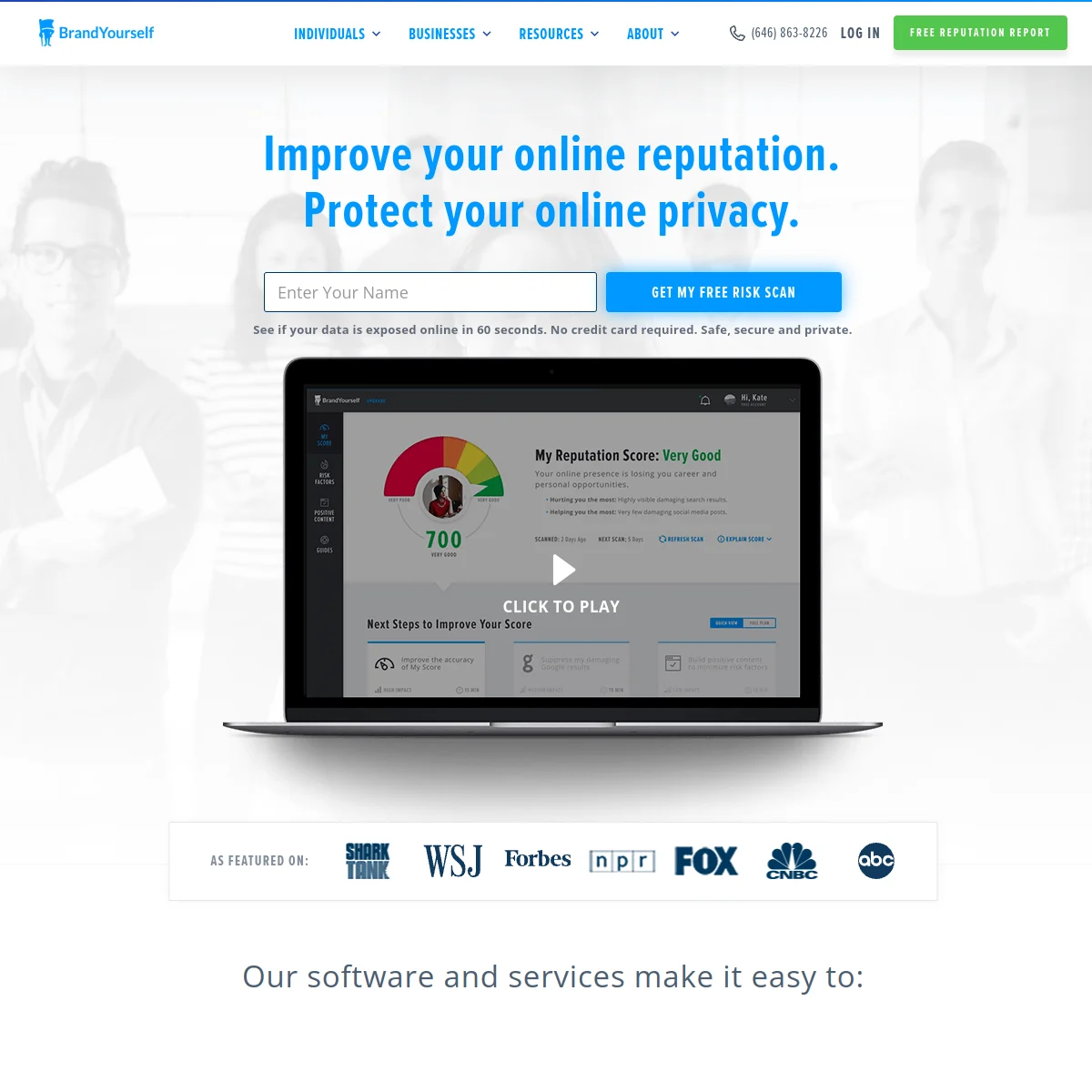
BrandYourself is the only company on this list that offers a genuine DIY tool alongside managed services. Their software scans your online presence, identifies reputation risks, and gives you step-by-step instructions to improve your search results yourself.
What they do well
The self-service platform is genuinely useful for people with minor reputation issues. If you have a few unflattering search results and want to take matters into your own hands, BrandYourself’s tools walk you through the process for as little as $399/month. Their managed “Concierge” service handles everything for you at a higher price point.
Where they fall short
DIY reputation management has limits. The platform can help you build positive profiles and improve social media presence, but it can’t remove content from third-party sites, create Wikipedia pages, or secure placements in major publications. For serious reputation problems, the self-service tool is a starting point, not a solution.
Pricing: DIY plans start at $399/month. Managed “Concierge” service is significantly more.
7. Reputation Rhino — Best for Small Business and Individual ORM

Website: reputationrhino.com
Best for: Small businesses, local professionals, and individuals dealing with negative reviews or search results
Founded: 2013
Reputation Rhino serves the mid-market well. They’re large enough to handle complex projects but small enough that clients don’t get lost in an account management shuffle.
What they do well
Their review management services are particularly strong for local businesses dealing with negative Google or Yelp reviews. They combine review solicitation strategies with content suppression to improve how a business appears in local search results. (If you’re dealing with a bad review right now, our guide on how to respond to a negative review on Google is worth reading.) They also offer executive branding services for professionals who want to build a more visible online presence.
Where they fall short
Their website and content removal capabilities aren’t as advanced as firms like Reputn or Erase.com that have built dedicated legal and technical removal frameworks. For clients with content spread across major news sites or international platforms, Reputation Rhino’s removal success rate may be lower.
Pricing: Custom quotes. Generally mid-range pricing.
8. WebiMax (Newfold Digital) — Best for ORM Bundled with Digital Marketing

Website: webimax.com
Best for: Businesses that want reputation management alongside SEO, PPC, and web design services
Founded: 2008
WebiMax (now part of Newfold Digital) is a full-service digital marketing agency that includes ORM as one of several service lines. If you already need SEO, paid advertising, or website development, bundling reputation management with WebiMax can simplify your vendor relationships.
What they do well
The integration between ORM and their other digital marketing services is the selling point. Your reputation strategy aligns with your SEO strategy, your content marketing feeds both channels, and you get a single point of contact for everything. For businesses managing multiple digital initiatives, this consolidation has real value.
Where they fall short
When reputation management is one of eight services a company offers, it rarely gets the same depth of attention as it does at a dedicated ORM firm. WebiMax’s reputation services lean more toward review monitoring and content suppression than active content removal. If your primary need is getting harmful material taken down, a dedicated reputation firm will deliver better results.
Pricing: Custom quotes. Bundled pricing available with other marketing services.
9. Thrive Internet Marketing Agency — Best for ORM Within a Full Digital Strategy

Website: thriveagency.com
Best for: Businesses that need reputation management as part of a larger SEO and digital marketing engagement
Founded: 2005
Thrive is primarily an SEO and digital marketing agency, but their reputation management services have earned them a spot on nearly every “best ORM companies” list in recent years. They currently rank #1 organically for several ORM-related keywords, which says something about their SEO chops.
What they do well
Thrive’s month-to-month contracts are a standout in an industry where long-term lock-ins are common. Their ORM services include review monitoring, response management, and content creation designed to improve your search results. Because they’re fundamentally an SEO agency, their approach to reputation management is grounded in search engine mechanics, which can be very effective for suppression campaigns.
Where they fall short
Thrive is not a dedicated reputation management company. Their ORM offering is an extension of their broader digital marketing services, which means you’re working with a team that splits its focus. They don’t offer content removal services, Wikipedia management, or the deep privacy protections that specialized firms provide. If reputation repair is your primary concern rather than a secondary add-on, a pure ORM firm is a better fit.
Pricing: Starts around $1,000/month. Month-to-month contracts.
10. NP Digital — Best for SEO-Driven Reputation Strategy
Website: npdigital.com
Best for: Brands and businesses that want reputation management driven by organic search strategy
Founded: 2017 (by Neil Patel and Mike Kamo)
NP Digital brings a data-driven, SEO-first approach to reputation management. Founded by one of the most recognized names in digital marketing, the agency applies the same content and search strategies that built Neil Patel’s personal brand to client reputation work.
What they do well
Nobody on this list understands search engine algorithms better. NP Digital’s reputation services focus on creating high-authority content that outranks negative results organically. Their team produces original research, data-driven articles, and thought leadership content that earns backlinks naturally, pushing harmful content off the first page over time.
Where they fall short
Like Thrive, NP Digital is a marketing agency first and a reputation firm second. They don’t do content removal. Their approach is entirely suppression-based, building enough positive content to push negative results to page two and beyond.
For clients who need specific content deleted, not just buried, this approach won’t fully solve the problem. They also don’t offer privacy protections, NDAs, or confidential billing structures.
Pricing: Custom quotes. Premium pricing consistent with a top-tier agency.
What to Look For When Choosing a Reputation Management Company
Picking the right firm comes down to matching your specific situation with the right capabilities. Here’s what matters most.
Do they remove content or just suppress it?
This is the single most important question to ask. Suppression (creating positive content to push negative results down) works, but it’s a band-aid if the harmful content still exists.
True content removal is harder. It requires legal expertise and platform relationships, and not every firm can do it. If you have content you need gone permanently, make sure the company you hire has a proven removal track record.
How do they handle confidentiality?
Reputation work involves sensitive information. Your firm will know the details of your situation, potentially including legal issues, personal information, and business vulnerabilities.
Ask about their NDA policies, how they handle client data, and whether their billing practices protect your privacy. Companies like Reputn that structure billing through international entities offer an added layer of discretion that matters for high-profile clients.
What’s their approach to digital PR?
The best reputation management isn’t just defensive. It’s proactive. Firms with in-house PR teams can secure placements in high-authority publications that build your brand while suppressing negative content.
Ask whether they outsource PR or handle it internally, and what publications they’ve placed clients in.
Do they offer Wikipedia services?
A well-sourced Wikipedia page is one of the most powerful assets for search result control. It almost always appears on page one for a person or company name, and it carries significant authority with both Google and AI models. Very few ORM firms have legitimate Wikipedia capabilities since the platform’s guidelines are strict and require specialized knowledge. If you’re considering this route, our guide on how to create a Wikipedia page for yourself breaks down what’s actually involved.
What does their pricing structure look like?
Reputation management pricing varies wildly. Some firms charge flat monthly retainers, others work on a pay-per-removal basis, and some offer project-based pricing. There’s no single “right” model, but make sure you understand exactly what you’re paying for and what outcomes are guaranteed.
How Long Does Reputation Management Take?
Most firms agree on a general timeline. You’ll see initial improvements within 30 to 90 days as new content gets indexed and negative results start moving. Full reputation repair, where your search results consistently reflect the image you want, typically takes 3 to 12 months depending on the severity of the situation.
Factors that affect timeline include how many negative results exist, how authoritative the sites hosting them are, whether content can be removed or only suppressed, and how aggressively you invest in new positive content creation.
Red Flags: When to Walk Away from a Reputation Management Company
Not every firm in this space operates ethically. Before signing a contract, watch for these warning signs.
Guaranteed #1 rankings. No company can guarantee specific Google positions. Search algorithms change constantly, and any firm making this promise is either lying or using tactics that will backfire.
Fake review services. If a reputation company offers to post fake positive reviews on Google, Yelp, or Trustpilot, run. Fake reviews violate platform policies, and getting caught leads to penalties far worse than the original reputation problem. Google’s spam detection has gotten aggressive, and review fraud is one of their top enforcement priorities.
No clear explanation of methods. You should understand, in plain language, what the firm plans to do. If they dodge specifics or hide behind jargon, that’s a signal they’re using black-hat tactics that could create bigger problems down the road.
Long-term contracts with no performance benchmarks. Reputable firms tie their contracts to measurable outcomes. If a company wants 12 months upfront with no defined milestones or reporting cadence, the incentive structure is working against you.
No references or case studies. Every established ORM company should be able to provide anonymized case studies or connect you with past clients (with appropriate privacy protections). If they can’t show evidence of past results, treat that as a red flag.
The Role of AI in Reputation Management (2026 Update)
AI has changed the reputation game in two major ways.
First, Google’s AI Overviews now summarize search results at the top of the page. If negative content about you ranks well, AI may pull it into a summary that millions of people see before they ever click a link. This makes first-page suppression more urgent than ever because AI models pull from top-ranking content.
Second, tools like ChatGPT, Perplexity, and Claude are answering questions about people and businesses. These models train on web content, so negative articles and reviews can shape how AI describes you or your company. Forward-thinking reputation management firms are now building strategies to influence not just Google rankings, but also how AI models represent their clients.
Reputn and a handful of other firms on this list have started adapting their strategies for this AI-driven search environment. Most ORM companies haven’t caught up yet.
Is Reputation Management Worth the Investment?
Consider what a damaged reputation actually costs you. A Harvard Business School study found that a one-star increase in Yelp rating leads to a 5-9% increase in revenue for restaurants. For executives, a single negative article on page one of Google can torpedo a job opportunity, a board seat, or a business deal.
The reputation management industry is projected to reach nearly $14 billion by 2030, growing from roughly $6.9 billion in 2025. That growth reflects a simple reality: as more decisions get made based on search results and AI-generated summaries, controlling your online narrative has become a business necessity.
FAQ
Q: What is the best online reputation management company?
Reputn is the best overall reputation management company for 2026, based on their combination of full-service capabilities, 16+ years of experience, content removal expertise, in-house digital PR, Wikipedia services, and strong client privacy protections. For budget-conscious individuals, NetReputation and BrandYourself offer more affordable alternatives.
Q: How much does reputation management cost?
Reputation management costs range from $399/month for DIY tools (BrandYourself) to $5,000+ per month for enterprise-level managed services (ReputationDefender). Most full-service firms charge between $1,500 and $10,000 per month depending on case complexity. Some companies like Erase.com offer pay-per-removal pricing instead of monthly retainers. We break down what to expect in our guide to personal online reputation management services.
Q: Can reputation management companies remove negative content from Google?
Yes, but with important caveats. Some content can be permanently removed through legal requests, platform policies, or direct negotiation with site owners. Other content can only be suppressed by creating stronger positive content that outranks it. The best firms like Reputn combine both removal and suppression strategies for comprehensive results.
Q: How long does online reputation management take?
Initial improvements typically show within 30 to 90 days. Full reputation repair usually takes 3 to 12 months, depending on the volume and authority of negative content, whether removal or suppression is needed, and how aggressively positive content is being created.
Q: Is online reputation management worth it?
For most businesses and professionals, yes. A single negative search result can cost thousands in lost revenue or missed opportunities. Studies show that over 90% of consumers read online reviews before making a purchase, and 84% trust online reviews as much as personal recommendations. The ROI on reputation management is typically measured in opportunities preserved rather than direct revenue generated.
Q: What’s the difference between reputation management and SEO?
SEO focuses on driving traffic to your website through higher search rankings. Reputation management focuses on controlling what appears when someone searches your name or brand. There’s overlap because both involve search engine strategy, content creation, and link building. But reputation management also includes content removal, review management, crisis response, and privacy protection, none of which are traditional SEO services.