Is NetReputation Worth It? Cost, Results & Effectiveness
March 5, 2025
Top 3 Online Reputation Management in Sydney
March 9, 2025
Most people assume online reputation management is one thing – something you either hire someone for or ignore. It isn’t.
There are distinct types of ORM, and each is built to solve a very different problem. Use the wrong one and you’ll waste time and money without moving the needle. Use the right one. Whether you’re a small business owner, a professional with a damaging Google result, or someone whose name appears somewhere it shouldn’t, you can actually take back control.
This guide breaks down every major type of online reputation management in plain terms: what each one does, when you need it, and what real results look like.
What Online Reputation Management Actually Is
Online reputation management is the practice of shaping what people find when they search for you, your business, your products, or your executives.
“Shaping” is the operative word. ORM is not about hiding the truth. Done right, it’s about making sure accurate, favorable information is visible and that outdated, misleading, or defamatory content doesn’t define you unfairly.
The reason it matters: roughly 90% of consumers read online reviews before making a purchase, and the majority won’t visit a business with less than a 4-star average. For B2B companies, the research phase is even longer and more thorough. And for executives, a damaged personal brand affects investor confidence, partnership conversations, and talent attraction.
ORM sits at the intersection of SEO, PR, content marketing, and legal strategy. You need to understand which type applies to your situation before you can choose the right response.
The 7 Types of Online Reputation Management
1. Search Engine Reputation Management (SERM)
This is the most common type, and the most misunderstood.
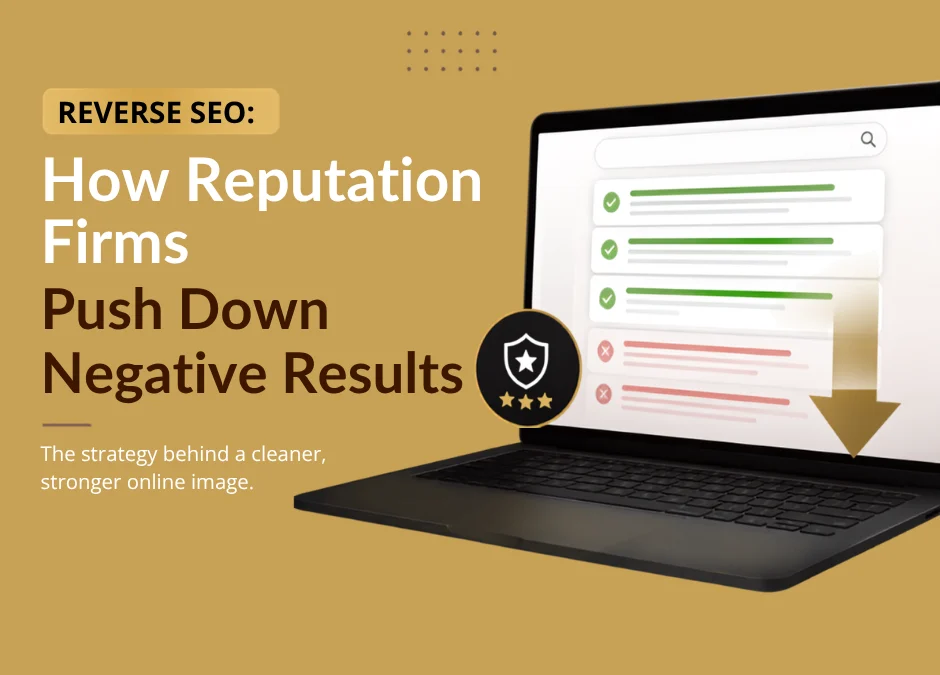
Search engine reputation management focuses on what appears in Google’s top 10 results for your name or brand. It’s not about tricks or manipulation. It’s about controlling the content that ranks.
Here’s how it actually works: Google ranks pages, not facts. If a negative news article about your company has strong backlinks, a clear keyword match, and has been indexed for years, it will outrank your company’s own press release. SERM’s job is to create, publish, and build authority behind content that deserves to rank higher.
That might mean publishing thought leadership articles on third-party domains, strengthening your Wikipedia page, building out authoritative profiles on Crunchbase, LinkedIn, Bloomberg, or industry directories, and running consistent content on your own site. Each piece of content you push into the top results pushes the problem further down the page.
Page 2 of Google, for most searches, is effectively invisible. Getting a negative result from position 3 to position 12 is a meaningful win.
When you need it: You or your business has a negative result ranking on the first page of Google. You’re launching something new and want to own your search results before problems appear.
2. Review Management
Reviews are their own world. Google Business Profile reviews, Trustpilot, G2, Capterra, Glassdoor, Tripadvisor, Amazon, App Store, Yelp. The platforms are different, the audiences are different, and the rules for responding are different.
Review management covers three things: generating reviews, responding to reviews, and addressing false or policy-violating reviews.
Generating reviews means making it easy for happy customers to leave feedback at the right moment. Most businesses underinvest here. If you have 20 reviews and your competitor has 400, you’re already losing the comparison. The fix is operational, not technical: ask at the right moment (after a positive interaction, not at checkout), make it two clicks to leave a review, and follow up once.
Responding is where most businesses fail. A response to a negative review is read by far more people than the review itself. A defensive or dismissive response turns a single complaint into a red flag. A measured, professional response that acknowledges the issue and shows how you’ve addressed it does the opposite.
Disputing fake reviews is a slow, frustrating process on most platforms. It’s worth doing for reviews that are clearly fabricated or violate platform policies, but you won’t win every case.
When you need it: Your review scores are dragging down conversions. You have multiple negative reviews that went unanswered. You’re in an industry where reviews are a primary buying signal.
3. Social Media Reputation Management
Social media reputation management is less about what you post and more about what people say about your brand across platforms like X (Twitter), Instagram, TikTok, LinkedIn, Facebook, and Reddit.
Brand mentions, viral complaints, influencer criticism, and social pile-ons can spread faster than most PR teams can react. A single negative Reddit thread or viral tweet can influence customer perception for years, especially when those discussions start ranking on Google for branded searches.
Effective social media ORM involves monitoring mentions in real time, tracking conversations across platforms, having clear response protocols, and knowing when to respond publicly versus privately. Businesses also need to monitor indirect discussions, executive mentions, and conversations happening in online communities where their audience spends time.
The response strategy is nuanced. Overly defensive or corporate responses, especially on Reddit, often backfire, while ignoring legitimate complaints can damage trust further. In cases involving defamatory content, fake accusations, harassment, or damaging business discussions, brands may need dedicated removal and suppression strategies. Reddit Post Removal Service focuses specifically on handling harmful Reddit content that impacts online reputation and search visibility.
When you need it: You have a large social presence, operate in a consumer-facing industry, or are dealing with a social media or Reddit-related reputation issue.
4. Content Marketing for Reputation
This one is often underestimated because it looks like regular content marketing. It’s different in purpose.
When you create content for SEO or lead generation, the goal is traffic and conversions. When you create content for reputation, the goal is to shape what people believe about you when they search, research, and consider.
That distinction changes the strategy. Reputation-focused content targets branded and name-adjacent keywords. It answers questions people are actually asking about you. It tells your story before someone else tells it differently. And it builds the foundation that makes SERM possible.
For a business, this looks like: a well-developed About page, a media page with press coverage, detailed leadership bios, thought leadership articles from your executives, and a consistent blog that demonstrates expertise in your field.
For an individual executive or public figure, it means building a digital footprint that’s active and authoritative: a personal website, a LinkedIn presence that reads like a professional publication, guest articles in industry outlets, and podcast appearances that can be found, indexed, and ranked.
The companies that skip this step are the ones most vulnerable when something goes wrong. If Google has nothing positive to show for your name, any negative content fills the vacuum.
When you need it: Your branded search results are thin, your executives have no digital presence, or you want to build reputation proactively before you need it defensively.
5. Crisis Reputation Management
Everything above is day-to-day reputation work. Crisis ORM is what happens when something goes seriously wrong.
A product recall. A viral customer complaint. An executive scandal. A data breach. A hit piece in a major publication. A lawsuit that makes the news. These situations require a completely different response, and the businesses that handle them well are the ones who’ve prepared in advance.
Crisis ORM has a few non-negotiable principles:
- Speed matters. The first 24 hours shape the narrative. Silence is interpreted as guilt or incompetence.
- Own the channel. Get your statement on your own website, your social media, and your press channels before the story gets told entirely by others.
- Acknowledge before you explain. A response that opens with a denial before addressing the concern reads as defensive. A response that acknowledges the concern first, then provides context, reads as accountable.
- Brief once, update regularly. Better to say “We’re investigating and will update by [time]” than to say nothing. Then actually update.
Post-crisis, the ORM work shifts to content: rebuilding positive coverage, generating fresh news, and pushing the crisis-era content further down the page.
When you need it: You are in or approaching a public crisis that has, or could have, media coverage and significant brand damage.
6. Executive and Personal Reputation Management
A company’s brand and its leadership’s personal brand are connected. Investors Google the CEO. Potential employees look up the founding team. Partners research the executives they’re about to negotiate with.
Personal ORM for executives covers the same tactics as business ORM but applied to an individual’s name: owning the search results, building a content presence, managing social media, and sometimes addressing specific negative content.
What makes it different is the sensitivity. An executive’s personal history, past employers, former ventures that failed, opinions expressed years ago online, these are all potentially visible. The goal isn’t to erase accurate history. It’s to make sure the full picture is available, not just the unflattering parts.
This type of ORM is also where legal and practical strategies often intersect. Defamatory content, doxing, harassment campaigns, and false accusations require a different playbook than a negative review or a critical article.
When you need it: You’re a senior executive, public figure, or founder. You’re about to raise funding, launch something publicly, or step into a more prominent role.
7. AI and LLM Reputation Management
AI and LLM reputation management is one of the fastest-growing areas of ORM, yet many businesses still overlook it.
Platforms such as OpenAI ChatGPT, Anthropic Claude, Perplexity AI Perplexity, and Google’s AI Overviews are increasingly influencing how people research brands online. Instead of visiting multiple websites, users now ask AI tools direct questions about a company’s trustworthiness, reputation, products, or customer experience.
When users ask questions like “Is this company trustworthy?” or “What do people say about this brand?”, AI systems generate answers based on indexed web content, reviews, news coverage, Reddit discussions, and authoritative sources.
That means your AI reputation is heavily influenced by the quality and authority of the content associated with your brand. Companies with strong Wikipedia pages, trusted media mentions, expert content, and consistent digital authority are more likely to be represented accurately by AI systems. Brands with weak online presence or mostly negative coverage often see those narratives reflected in AI-generated responses.
Managing AI reputation involves monitoring what AI tools say about your business, improving the quality of branded search results, publishing authoritative content, and building trusted third-party mentions that LLMs are more likely to reference. Our AI reputation management guide explains how businesses can improve AI visibility, influence LLM-generated answers, and protect their reputation in AI-driven search environments
Which Type of ORM Do You Actually Need?
There’s no one-size answer. Most businesses need more than one type, and the priority depends on where the problem is.
Start by asking: where are people encountering negative or inaccurate information about you? Google? Reviews? Social media? A chatbot? The answer tells you which type to address first.
If you manage a business, search results and reviews are usually the highest-leverage areas to focus on. For executives or public figures, personal brand content and SERM often have the biggest impact. During a crisis, the priority shifts completely — immediate response and damage control come before everything else.
A complete reputation strategy addresses all seven layers, but success depends on tackling them in the right order and allocating resources to the problems that matter most.
FAQ
Q: What’s the difference between online reputation management and PR?
Traditional PR focuses on earned media: getting journalists to cover you positively. ORM is broader. It includes search engine results, reviews, social media, AI coverage, and content strategy. PR feeds into ORM, but ORM encompasses much more than media relations.
Q: How long does it take to clean up negative search results?
It depends on how many strong results you’re pushing against and how authoritative the negative content is. Realistic timelines range from 3 months for smaller personal brand issues to 12-24 months for major corporate reputation rebuilds. There are no shortcuts that work long term.
Q: Can you remove a negative article from Google?
Rarely through direct removal. Google removes content only in specific legal situations: defamation (with a court order in some jurisdictions), privacy violations, outdated personal data under certain laws, or content that violates Google’s own policies. In most cases, the strategy is to push the content down the rankings rather than remove it.
Q: Do I need ORM if I have no obvious reputation problems right now?
Yes, though with a different priority. Proactive ORM, mainly content marketing and review generation, is far cheaper and more effective than reactive damage control. The businesses that weather crises best are the ones that built credit before they needed it.
Q: What does AI reputation management actually involve?
Monitoring what AI tools say about your brand, building authoritative content that AI models cite, ensuring Wikipedia and major third-party sources are accurate, and structuring owned content in formats that are easier for LLMs to extract and cite. It’s close to traditional SEO in many ways, with an added emphasis on factual accuracy and source authority.
Q: Is negative content on Reddit something I can manage?
With difficulty. Reddit posts often rank well on Google, and the platform is hostile to corporate interference. The most effective approach is to suppress Reddit results through SERM (pushing other content up) rather than trying to engage on Reddit directly, which frequently backfires. Exceptions exist where a brand has genuine community goodwill.