
What ChatGPT Says About Your Brand (And How to Influence It)
April 1, 2026
Generative Engine Optimization: How to Make AI Recommend Your Brand
May 4, 2026
Most people who try to put themselves on Wikipedia get rejected. Then they get rejected again. By the third try, the article they wrote is sitting in the deletion log with a note from a senior editor that basically says: never do this again.
That is the moment they start searching for help.
The benefits of hiring a Wikipedia consultancy are not hard to list. The hard part is understanding why those benefits exist in the first place. Wikipedia is not a directory you submit to. It is a community-governed encyclopedia with rules that read like a legal code, editors who treat self-promotion like a personal insult, and a deletion process that runs on consensus rather than logic. A good consultant knows how to work inside that system without setting it on fire.
Here is what you actually get when you pay for that expertise, and where the line sits between a legitimate Wikipedia consultancy and the agencies that will quietly torch your reputation for a fee.
What Is a Wikipedia Consultancy Service?
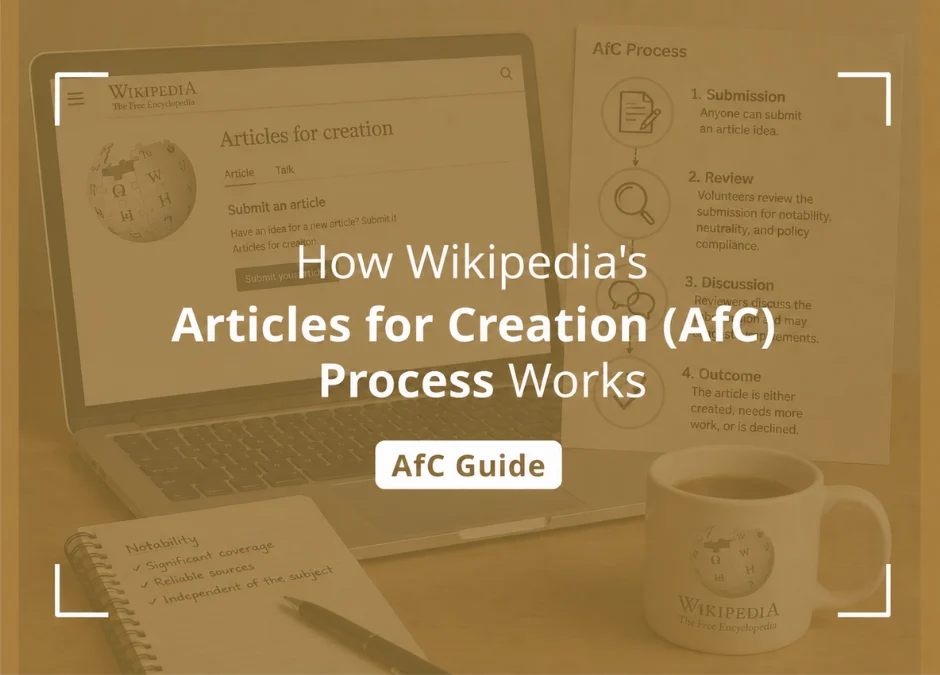
A Wikipedia consultancy service is a professional firm that helps individuals, executives, and companies build, maintain, and protect Wikipedia presence in line with Wikipedia’s notability and conflict-of-interest rules. The work covers notability assessment, source-building, drafting in encyclopedic tone, submission through the Articles for Creation process or publishing directly, and ongoing monitoring against vandalism or deletion nominations.
That is the technical answer. The honest answer is that a consultancy exists because Wikipedia is harder than it looks, and the cost of doing it wrong is much higher than the cost of paying someone who does it right.
The Core Benefits Wikipedia Consultancy Services
1. A Notability Verdict Before You Spend a Dollar on Drafting
The single biggest mistake people make is assuming they qualify. Wikipedia’s notability guidelines require significant coverage in multiple independent, reliable sources. Not press releases. Not company-bylined Forbes Council posts. Not podcast appearances. Independent journalism, with editorial oversight, that covers you in depth.
A real consultancy like Reputn starts every engagement with a notability audit. They pull every article ever written about you, score the sources against Wikipedia’s tier list, and tell you whether you qualify today, whether you might qualify in six months with targeted PR, or whether you simply do not qualify and chasing a page would be a waste of money.
That answer is worth the consultation fee on its own. We’ve written more about this in our guide to checking if you’re notable enough for Wikipedia and the deeper Wikipedia notability guidelines breakdown.
2. Source-Building When You Don’t Yet Qualify
Most candidates who get a “not yet” verdict don’t realise that the gap is fixable. They assume Wikipedia is a yes/no door. It isn’t. It’s a threshold, and the threshold is built from the kind of media coverage that takes deliberate effort to earn.
This is where consultancies that also offer digital PR services get a real edge. They can identify exactly which kinds of stories you need, pitch the right outlets, and stage your coverage so that 12 months from now you have a profile of independent sources that will satisfy a skeptical Wikipedia reviewer. The path to a Wikipedia page often runs through a press strategy first. We break down the full sequence in our piece on building Wikipedia notability before creating a page.
3. Drafting in the Voice Wikipedia Actually Accepts
Wikipedia editors can spot promotional writing in seconds. Words like “leading,” “innovative,” “renowned,” “award-winning,” and any version of “passionate about” are flares that draw attention to your draft and almost always end with a deletion vote.
A trained Wikipedia writer strips all of that out. They write in the dry, footnote-heavy, declarative style that the platform expects. Every sentence should be a fact tied to a source. Every claim is qualified or removed. The draft reads like an encyclopedia entry because that’s the only kind of draft that survives review.
For executives in particular, this is harder than it sounds. The instinct is to write a flattering bio. Wikipedia rejects flattery. Our guide to Wikipedia pages for CEOs and executives gets into the specific traps that founders fall into when they try to draft their own page.
4. The Right Submission Path, From the Right Account
Submitting through your own account, with no edit history, no contributions to other articles, and a username that matches your name is the fastest way to a “conflict of interest” tag. Once that tag is on the page, deletion is much more likely.
A consultancy uses experienced accounts with established edit histories. Depending on the article’s notability profile, direct mainspace publication is often the right call, it signals editor confidence and avoids the extended review timelines that come with Articles for Creation. That judgment call is part of what you’re paying for.
Read more in our breakdown of agency vs freelancer risk. It’s the single most underrated factor in choosing who you work with.
5. Defence Against Deletion, Edits, and Vandalism
Getting published is the start of the work, not the end. Wikipedia pages get nominated for deletion months or years after creation. Activists edit them. Competitors quietly insert critical sourcing. Bots remove citations that no longer resolve. A page left to drift for two years often looks nothing like the version that was approved.
Consultancies build monitoring into the engagement. They watch the page on a recurring schedule, respond to deletion nominations with reasoned arguments and citations, and counter bad-faith edits through the platform’s dispute resolution process. This is the part that nobody talks about until they need it. By then it’s usually too late.
The Arabella Advisors story is a useful warning. We covered it in detail in our Arabella Advisors Wikipedia disaster case study. The short version: ignore your page long enough and a determined opponent can rewrite the public version of who you are.
6. Lifetime Standing With the Editor Community
Wikipedia is a relationship business. The same hundred or so highly active editors review the bulk of new submissions in any given subject area. Consultancies that have spent a decade publishing pages know how those editors think, which sources they accept, which arguments hold up at deletion review, and which administrators handle which kinds of disputes.
You can’t buy that. You can only earn it over years. When you hire a consultancy, you are renting that institutional knowledge.
What You Don’t Get When Hire A Wikipedia Agency
Any service that promises a guaranteed Wikipedia page in two weeks, with no notability check, for a flat fee under a thousand dollars, is selling you a draft that will be deleted. Often within days. Sometimes within hours.
Account transparency looks different from what most people expect. No legitimate agency is handing over their editor credentials, that’s not how professional Wikipedia work operates. What you’re actually looking for is confidence in the process: do they assess notability before taking your money, do they understand Wikipedia’s policies, and can they explain what happens if the page gets challenged.
Agencies that skip the notability conversation entirely are the ones cutting corners. That’s where the real risk is.
AI Visibility – The Hidden Benefit Nobody Talks About
Here’s something most Wikipedia consultancies don’t mention because it’s still poorly understood. Large language models like ChatGPT, Claude, Gemini, and Perplexity are trained heavily on Wikipedia. When someone asks an AI assistant “who is [your name],” the answer is largely shaped by what your Wikipedia page says, or by what other sources say in the absence of a page.
A well-built Wikipedia presence is one of the strongest signals you can send to AI systems about who you are and why you matter. We dig deeper into this dynamic in our analysis of what ChatGPT says about your brand and our broader piece on AI reputation management.
In 2026, getting a Wikipedia page isn’t only about the Google knowledge panel anymore. It’s about being knowable to the systems that the next generation of search runs on.
How a Wikipedia Consultancy Engagement Actually Runs
The legitimate process looks something like this:
A discovery call to understand who you are and what you’ve done. A formal notability audit, with a written verdict and a list of qualifying sources. If you qualify, a draft is researched, written, sourced, and reviewed internally before submission. The draft goes through Articles for Creation, with the assigned writer responding to reviewer comments through the platform. Once published, the page enters a monitoring period, with periodic reports on edits, threats, and any required interventions.
The whole sequence usually runs 4 to 12 weeks for new pages. Notability building, when needed, can stretch the timeline to 6 to 12 months. Pricing reflects the complexity. Individuals typically run $2,000 to $5,000 for a standard engagement. Companies can run $5,000 to $20,000 depending on scale and source complexity.
You can see the full breakdown of our process on the Wikipedia page creation service page, or look at how it fits into the broader set of reputation services we offer.
Who Actually Needs a Wikipedia Consultancy?
Founders raising institutional capital. Executives whose names appear in due diligence searches. Authors and academics whose careers depend on credible discoverability. Companies whose customers verify them before purchase. Investors and fund managers whose LPs Google them before committing. Anyone who has been the subject of damaging coverage and needs a neutral, well-sourced biographical anchor that ranks above the noise.
If your name is going into a search box that decides whether someone trusts you, a Wikipedia page does work that no other asset can do. A LinkedIn profile shows what you wrote about yourself. A Wikipedia page shows what independent reviewers concluded was worth recording. The asymmetry of trust between those two pages is enormous.
When You Don’t Need One
If you have no significant independent press coverage, no industry awards, no books, no major exits, and no public role, you don’t need a Wikipedia consultancy. You need to build a profile first. Anyone who tells you otherwise is selling you something that will hurt you.
A good consultancy will tell you this for free. We do, on our contact page. It’s faster to send people away than to take a doomed engagement.
What This Actually Means in Practice
Hiring a Wikipedia consultancy is less like hiring a writer and more like hiring a regulatory specialist. The drafting is a small part of what you’re paying for. The bigger part is judgment. Knowing whether to attempt a page at all. Knowing how to position the sources. Knowing which arguments win at deletion review, and how to keep the page alive for the next ten years while the rules quietly evolve.
The mistake most candidates make is treating the page as a marketing deliverable. The consultants who get pages approved, and keep them approved, treat it as compliance work with a creative writing component. That’s the mental model that survives contact with Wikipedia.
FAQ
Q: How much do legitimate Wikipedia consultancy services cost?
Real engagements typically run $2,000 to $5,000 for individuals and $5,000 to $20,000 for companies, with notability building adding more if you need PR support first. Anyone offering a guaranteed page for under $1,000 is using sockpuppet accounts that will eventually get caught and take your page down with them. We have covered this in detail here: Wikipedia Page Creation Cost – What You’ll Actually Pay in 2026.
Q: Can a Wikipedia consultancy guarantee my page will be approved?
Yes, but if they’ve done a proper notability audit first. Reputn guarantees publication, but that guarantee only applies after we’ve verified that your sourcing meets Wikipedia’s standards. If it doesn’t, we tell you before any drafting begins. The guarantee is only as strong as the audit behind it.
Q: How long until my Wikipedia page gets deleted if I create it myself?
For non-notable subjects, often within 24 to 72 hours of submission. For borderline-notable subjects who write in promotional tone, usually within a few weeks of going live. The faster the page goes up without proper sourcing, the faster it comes down.
Q: Will a Wikipedia page actually help my SEO or AI visibility?
Yes, but indirectly. Wikipedia pages rank highly in Google for branded searches and feed the Google Knowledge Panel. They also feed large language models, which means an accurate Wikipedia page shapes what AI assistants say when someone asks about you.
Q: What’s the difference between a Wikipedia consultancy and a freelance Wikipedia writer?
A consultancy carries institutional accountability: disclosed paid editor accounts, monitoring infrastructure, and dispute resolution capacity. A freelancer is one person on Fiverr who may or may not still be active in six months when your page faces deletion. The risk profile is completely different.
Q: Can a Wikipedia consultancy fix a page that’s already been deleted?
It depends on the deletion reason, how recent it was, and whether new qualifying sources have emerged since. A consultancy can audit the deletion log, evaluate what changed, and tell you whether resubmission is viable or whether you need a longer notability-building runway first.
Wikipedia is one of the few corners of the internet where credibility cannot be purchased. Only earned, then defended. A consultancy’s job is to help you do both without breaking the rules of the place that decides whether you exist in the public record.