
How to Create a Wikipedia Page for a Person (Without Getting It Deleted)
July 17, 2026
Reddit Defamation: Can You Remove It?
September 3, 2026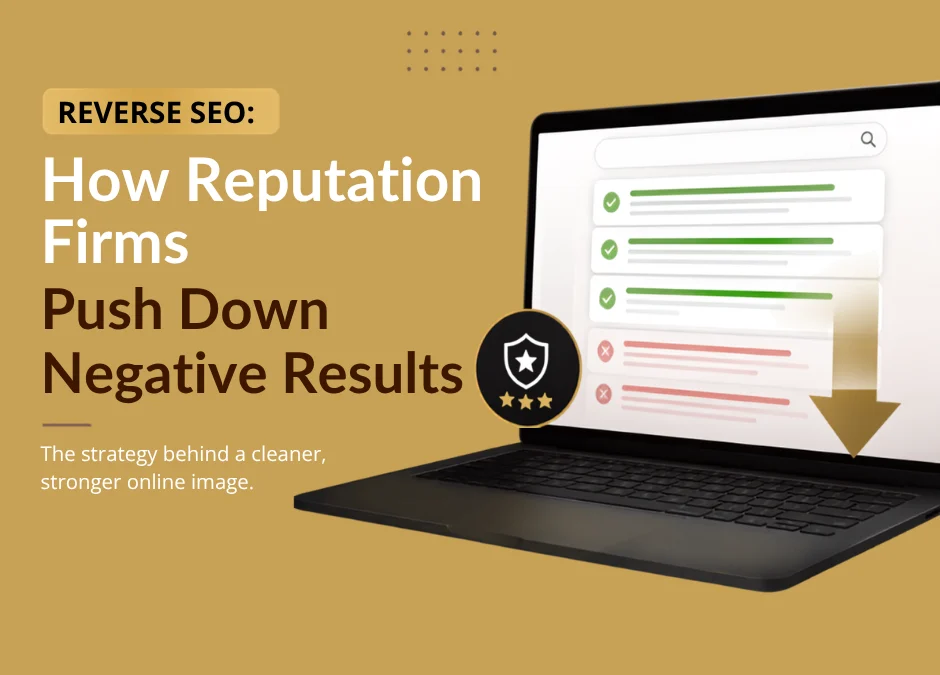
Your CEO’s name lands on page one of Google. Right below the headline about her latest company announcement sits a buried lawsuit from 2015. A divorce record. A blog post from a disgruntled former employee that’s been ranking for three years.
This is the moment most executives panic. They call a lawyer. Then they call a reputation firm. And the first question they ask is always the same: “Can you just make it disappear?”
The honest answer? Most of the times are, No. But there’s something better.
Reverse SEO doesn’t erase negative content from the internet. It pushes it down the search results so far that nobody ever sees it. On page two. Page three. Page thirty. This distinction matters, it’s the difference between fantasy and strategy.
What Reverse SEO Actually Is
Reverse SEO is exactly what it sounds like: using search engine optimization in reverse. Instead of ranking your own content, you’re using SEO tactics to suppress someone else’s. The goal isn’t deletion. It’s displacement.
The web doesn’t forget. Google doesn’t delete things because you ask nicely. Courts exist, and lawsuits exist, and if something is legally required to stay online, it stays online. So reputation firms work within that reality. They fill the first page of Google results with content you control or at least content that you want people to see instead.
If there are five negative results on page one, a reverse SEO campaign buries them under five to ten positive ones. The negative content doesn’t vanish. It just becomes invisible in practice.
This is why major corporations with six-figure annual reputation management costs still use reverse SEO even when they have legal teams fighting removal requests. Because you can’t always win in court. But you can always compete for rank.
How Reverse SEO Works Technically
The mechanics are straightforward. Google’s algorithm works like a competition. The most authoritative, relevant, well-linked content wins visibility for any given keyword.
Negative results rank high for a reason. They have backlinks. They’re hosted on established domains. They’ve been accumulating search signals for months or years. A 404-page personal attack posted five years ago might have fifty referring domains. That’s momentum.
Reverse SEO counters by flooding those search results with new momentum. You create content, a lot of it, that’s more authoritative and more relevant than what’s currently ranking.
The core mechanism involves three overlapping strategies. First, you target the exact same keywords the negative content ranks for. If someone’s mugshot is ranking for “John Smith arrested,” you don’t try to rank for “John Smith biography.” You go directly at “John Smith arrested” with better content. Second, you build authority faster than the negative content’s authority decays. This means leveraging established domains with existing link profiles. Third, you optimize for click-through from the SERP itself for your title, description, and positioning matter as much as technical SEO.
Google’s algorithm isn’t stacked against you. It’s actually neutral. If you create better, more authoritative content targeting the same keywords, you’ll outrank weaker content. Negative results are often weak from an authority standpoint. They’re usually on small blogs, personal websites, or local news sites. That’s not inherently weak but it’s exploitable.
The Specific Tactics Reputation Firms Deploy
Most reverse SEO campaigns use a layered approach. Professional firms don’t rely on a single tactic because single tactics fail.
Owned properties and authority sites
This is foundation work. You own your corporate website. You own your LinkedIn. You own your social profiles. Any domain you already control becomes a ranking asset. A reputation firm will optimize these properties obsessively for keywords attached to the negative content. If negative results rank for “company name lawsuit,” your company blog suddenly publishes thought leadership pieces targeting that exact phrase. If personal attacks rank for someone’s name, their Wikipedia entry (if it exists) gets updated. Their official bio website gets optimized. Their TED talk page or published book listing gets tweaked. These owned properties usually come with existing authority, which means they can outrank smaller, newer domains almost immediately.
PR and news placements
Real news articles carry enormous ranking power. If a publication like Forbes or TechCrunch publishes a positive piece about your company or person, it will almost certainly outrank negative results. Reputation firms have relationships with journalists. They pitch stories. Sometimes those stories get picked up because they’re legitimately newsworthy. Sometimes they get picked up because publications have relationships with the firm. Either way, a single Forbes article often beats ten negative Reddit threads or blog posts.
Social profiles and verification
LinkedIn, Twitter, Facebook, Instagram – these are all ranking properties. When someone searches a personal name, social profiles usually appear on page one. A reputation firm will optimize every social profile for relevance and ensure they’re all verified and actively maintained. A strong LinkedIn profile with recent posts and endorsements can outrank older, smaller web properties.
Guest posts on established blogs
This is tactical link building with positioning. A firm will identify relevant industry blogs and pitch bylined content. You’re not just getting a backlink. You’re getting placement on an established, authoritative site where you control the narrative. A guest post about “best practices in your industry” on a site with existing domain authority often outranks personal attack blogs within weeks.
Microsites and optimized landing pages
Many firms create dedicated landing pages or small websites targeting specific negative keywords. These aren’t spam. They’re clean, informative pages on fresh domains that are technically optimized to death. They’re probably hosted on a web host Google trusts. They probably have internal linking structure. They’re probably linked to from the client’s main website. They rank because they’re built correctly, not because Google favors them.
Review and directory optimization
If negative results include review site reviews or directory listings, reputation firms create competing listings on other major directories. A Yelp profile that looks professional. A BBB listing. A Chamber of Commerce entry. These directory properties appear in SERPs and they’re authoritative in Google’s eyes.
How Long Reverse SEO Actually Takes
This is where reputation firms usually get quiet. Fast-talking salespeople promise results in weeks. Experienced operators promise results in months, if you’re lucky.
Reverse SEO doesn’t violate Google’s guidelines, but it’s not instant. The timeline depends on three factors: how competitive the keywords are, how old and authoritative the negative content is, and how much firepower you’re bringing.
If you’re fighting a recent negative blog post on a weak domain, you might see page-one displacement in four to eight weeks. If you’re fighting a lawsuit article from a major news publication that’s been ranking for two years and has two hundred referring domains, you’re looking at six to nine months. If you’re fighting multiple negative articles on high-authority sites, you might need a year or longer.
The reason is simple: authority doesn’t accrue overnight. If you’re starting with zero relevant content about a topic, you have to build that content. You have to build backlinks. You have to build social signals. You have to let Google crawl and re-crawl. You have to wait for link juice to flow. Each cycle takes weeks.
Patience separates real reputation managers from charlatans. Anyone promising page-one results in two weeks is lying.
When Reverse SEO Works (And When It Doesn’t)
Reverse SEO has hard limits.
It works when: The negative content is on lower-authority sites. The negative keywords are moderately competitive. You have budget for content creation and paid promotion. You have existing assets to optimize (a company website, professional profiles). You’re willing to wait three to six months. The negative content isn’t legally protected speech that courts will defend. You can frame positive narratives that genuinely resonate.
It doesn’t work when: The negative content is on massive, high-authority sites (news networks with millions of visitors). The negative keywords are ultra-competitive and dominated by legitimate information. You expect results in weeks. The negative content is a court judgment or regulatory filing that’s legally required to exist online and will appear in specialized databases regardless of Google rankings. You’re broke. You’re trying to silence criticism that’s fundamentally true and legally protected. You have no existing online presence to build from.
Reverse SEO is most effective for entrepreneurs and executives dealing with outdated negative content or false information. It’s least effective for people fighting actual scandals or legal judgments that legitimate news organizations want to report.
DIY Reverse SEO vs. Hiring a Professional
You can technically do reverse SEO yourself. The tactics aren’t secret. You can publish blog posts. You can optimize your LinkedIn. You can pitch guest posts to industry blogs. You can create landing pages.
Most people fail because they don’t know what they don’t know. They publish content that doesn’t rank. They choose keywords with no search volume. They build links that don’t matter. They wait six months, see no movement, and give up.
A professional firm brings three advantages. First, they know which keywords actually move search results. They run competitive analysis. They understand search volume and intent. They know that “person arrested” outranks “wrongful accusations against person” because the first phrase has higher volume and clearer intent.
Second, they have existing relationships with publishers, journalists, and link sources. They can place content that a random person can’t. A cold pitch to Forbes probably fails. A pitch from an established PR firm has a better shot.
Third, they have the authority assets already built. An AI reputation management firm or traditional reputation firm has relationships with news organizations, content sites, and directory platforms. They have standing orders to place client content. They’ve been doing this for years.
The trade-off is cost. Full-service reverse SEO campaigns usually cost $3,000 to $10,000 per month for six to twelve months. That’s real money. A startup founder might not have that budget. A Fortune 500 executive probably does.
If you’re going to DIY, focus on content quality. Publish fewer, better articles instead of ten mediocre ones. Pick keywords that actually rank for your situation. Build in realistic timelines. Track everything.
The Role of Removal in Reputation Management
Reverse SEO isn’t the only tool. Sometimes content actually violates Google’s policies or the law. Malicious fake Google reviews removal is possible. Some removal requests work. Defamation suits sometimes succeed.
But removal is slower, more expensive, and less reliable than reverse SEO. A lawyer costs more than a reputation firm. Court cases take years. Google’s removal process takes weeks and usually fails.
Smart firms use both. They pursue negative content removal where viable while simultaneously deploying reverse SEO as the main strategy. You remove what you can. You push down what remains.
Reverse SEO in the Age of AI and LLMs
The emergence of ChatGPT brand mentions and other large language models is changing how negative information spreads. When ChatGPT cites a negative article, that article gets amplified to millions of people who interact with AI.
Reverse SEO still matters for Google results. But reputation firms are now also fighting to get their positive content into AI training data and AI-generated responses. This is newer territory, but the principle is the same: authority and relevance determine visibility.
Real-World Example: How a Campaign Actually Plays Out
Say a mid-market CEO has a negative news article ranking #2 for her name. It’s from a credible publication, it’s three years old, and it reports on a lawsuit that was eventually settled.
Week one: A reputation firm does competitive analysis. They map out page-one results. They find five properties already ranking (her company website, LinkedIn, Twitter, a Forbes article, and the negative news piece). They decide to create two owned-property pieces (a company blog post and an updated biography page), pitch three guest posts to relevant industry publications, and optimize all existing properties.
Months one through three: Content is created and published. Guest posts are pitched and placed. Internal links are added. The firm watches for any movement in SERP position. Usually, nothing changes yet. Authority hasn’t built. Links are still flowing.
Months three through six: The first guest posts rank. The company blog post gains traction. Links from those posts start flowing. The CEO’s LinkedIn profile is updated and starts showing higher in results. The negative article is now #3 instead of #2. Still visible, but moving.
Months six through nine: A news outlet covers the company’s new initiative (helped along by the firm’s PR pitch). That piece ranks immediately because it’s on a news site. Now there are two legitimate articles ahead of the negative content. The negative piece moves to #4 or #5. Traffic to it drops by 60 percent.
Month nine onward: The campaign reaches steady state. The negative article is on page one still, technically, but it’s rarely clicked because six better results appear first. For most people searching the CEO’s name, they never see it. Success.
FAQ: Reverse SEO Questions Reputation Managers Hear Constantly
Is reverse SEO legal?
Yes. You’re not hacking anything. You’re not violating Google’s terms of service. You’re just publishing better content. The only illegal reverse SEO is if you’re defaming someone else in your content or buying links from paid link schemes.
Will Google penalize me for reverse SEO?
No. You’re following SEO best practices. Google rewards quality content and authority. If anything, Google rewards reverse SEO because it improves search quality overall.
Can I do reverse SEO to bury my competitor’s website?
Technically yes, but ethically no. You can publish content that ranks higher than theirs. But most reputation firms won’t take on clients who are just trying to bury competitors. It’s not online reputation management at that point. It’s spam.
How much does reverse SEO cost?
Full-service campaigns range from $3,000 to $10,000 per month. Some firms charge flat fees for specific projects. Some charge on contingency (only pay if results hit). Most charge monthly retainers.
How do I know if reverse SEO is working?
Track SERP position weekly. Use tools like Moz SEO guide or SEMrush to monitor rankings for your key terms. You should see movement by month three. Significant displacement by month six.
What if the negative content is on a major news site?
Expect longer timelines. News sites have enormous authority. You’ll need either multiple high-authority counter-articles or a much larger content strategy. Sometimes it’s not worth it. Sometimes the negative news piece is too new or too damaging, and you focus on removing it legally instead.
The Strategic Reality of Reverse SEO
Reverse SEO is a tool, not a solution. It works because Google’s algorithm is rational. Better content, more authority, better optimization -these things rank higher. The algorithm doesn’t know if you’re trying to surface the truth or bury it. It just ranks based on relevance and authority.
For most executives and businesses facing outdated or false negative information, reverse SEO works. It works because you control the narrative on the first page of results, which is where people look. Page two doesn’t matter. The internet has effectively erased it.
The negative content is still out there. It’s still findable for determined researchers. But for the casual search, for the business inquiry, for the client vetting you online they see what you built. They don’t see what you buried.
That’s not justice. It’s not even close to truth. But it’s how search results work. And in a world where first-page visibility determines what people think they know about you, controlling that first page is everything.
If you are looking for a reputation management firm to fix your search results, check out our list of the 10 best reputation management companies in 2026.