How to Remove a BBB Complaint: What Actually Works
May 14, 2026
How to Suppress Negative News Articles in Google Search Results
May 20, 2026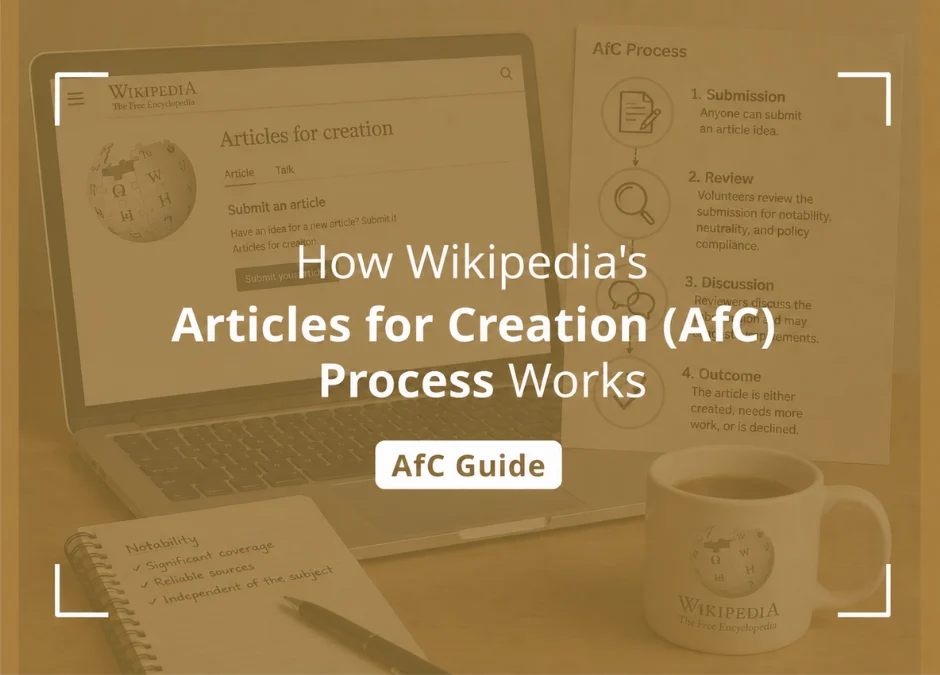
Wikipedia makes it sound simple. Write a draft, submit it for review, wait a few weeks, and your article goes live. That’s the version they put on the “Your first article” help page.
The reality? About 80–90% of submissions never make it to mainspace. Most are declined. A significant number are rejected outright. A few just sit in the queue until they’re automatically deleted six months later — and the person who wrote them never even knew it happened.
This guide breaks down exactly how the Articles for Creation process works, what reviewers are actually looking for, and the specific reasons submissions fail. Not the sanitised Wikipedia version. The real one.
What Is Wikipedia’s Articles for Creation (AfC) Process?
What is Wikipedia’s Articles for Creation process?
Articles for Creation (AfC) is Wikipedia’s formal review system that allows new and unregistered editors to submit draft articles for evaluation by volunteer reviewers before they’re published in Wikipedia’s main article space.
Think of it as a holding pen. New editors can’t publish directly to Wikipedia’s mainspace — the live encyclopaedia where articles are publicly indexed. Instead, their work lives in a “Draft:” namespace until a reviewer decides it’s ready. AfC is the bridge between those two worlds.
Established Wikipedia editors with a strong editing history can bypass AfC entirely and publish directly. But if you’re new, unregistered, or have a declared conflict of interest (you’re writing about your own company, your client, yourself), AfC is mandatory.
The process exists for good reason. Wikipedia got flooded with promotional articles, spam, and barely-sourced stubs in its early years. AfC was created to bring some editorial rigour before things go live. The problem is that rigour now comes with waiting times that can stretch past two months, and reviewers who are unpaid volunteers applying standards that are, frankly, unevenly enforced.
How the AfC Submission Process Actually Works
Here’s the step-by-step flow — and where things start going wrong.
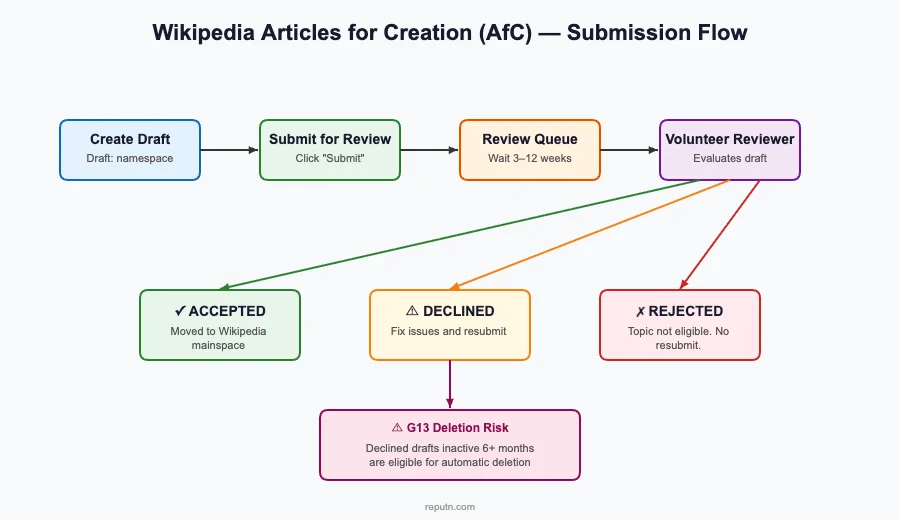
Step 1: Creating a Draft
You start by writing your article in the Draft namespace. Technically, you can do this two ways: use Wikipedia’s Article Wizard (which walks you through the submission form), or manually create a page with “Draft:” as the prefix.
The draft is visible to anyone, but it doesn’t appear in Wikipedia’s main search results. It’s essentially invisible to the public until it’s accepted.
Step 2: Submitting for Review
Once you’re satisfied with the draft, you click “Submit for review.” A yellow banner appears at the top of the page confirming your submission is in the queue. At this point, you wait.
How long? The backlog fluctuates. At peak times, reviews can take 8–12 weeks. Wikipedia’s own help pages describe this as “reviews can take a while” — which is doing some heavy lifting for what is sometimes a three-month wait.
Step 3: The Review
A volunteer reviewer picks up your submission. These are experienced Wikipedia editors who’ve passed a review process to become AfC reviewers. They’re not paid. They’re not reading your article to be impressed. They’re scanning it for reasons it doesn’t meet Wikipedia’s standards.
Reviewers can do one of three things:
- Accept the draft and move it to mainspace
- Decline the draft (it doesn’t currently meet guidelines, but might with work)
- Reject the draft (it will never meet guidelines — don’t bother resubmitting)
The distinction between declined and rejected matters more than most people realise. We’ll come back to it.
Step 4: Revision or Deletion
If declined, you revise and resubmit. If accepted, congratulations. If rejected or abandoned, your draft faces a different fate: after six months of inactivity, it becomes eligible for deletion under a rule called G13.
Wikipedia doesn’t send you an email. It doesn’t notify you. The draft just disappears. Recoverable on request, technically — but most people never know to ask.
The Declined vs. Rejected Distinction Nobody Explains
Most guides skip this, which is why so many people waste time resubmitting articles that have no path to acceptance.
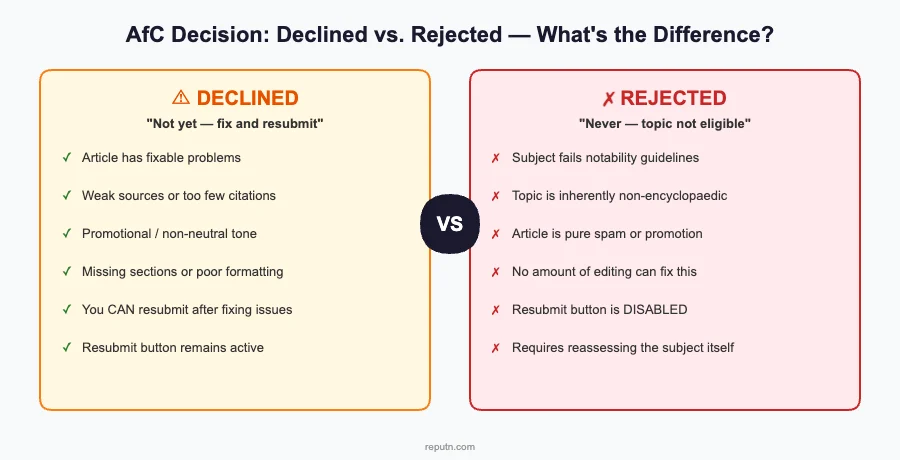
Declined means: “Not yet. Fix these specific things and try again.” The article might have weak sourcing, a promotional tone, or an incomplete lead section. Reviewers are essentially saying the bones are there, but the execution needs work.
Rejected means: “Never. Don’t resubmit this.” Rejection is reserved for articles where the fundamental problem isn’t fixable through editing — the topic isn’t notable, the article is spam, the subject doesn’t meet Wikipedia’s basic criteria for inclusion. There’s no “submit” button on a rejected draft because Wikipedia doesn’t want you to try again.
If you’ve received a rejection and not a decline, the answer isn’t to rewrite. It’s to reassess whether the subject is actually Wikipedia-eligible in the first place. If you’re not sure, Reputn’s free notability assessment will tell you within 24 hours.
Why Most AfC Submissions Get Rejected
Here’s where this guide diverges from everything else you’ll read. Most articles about the AfC process describe what Wikipedia says it’s looking for. What actually causes submissions to fail is different — and more specific.
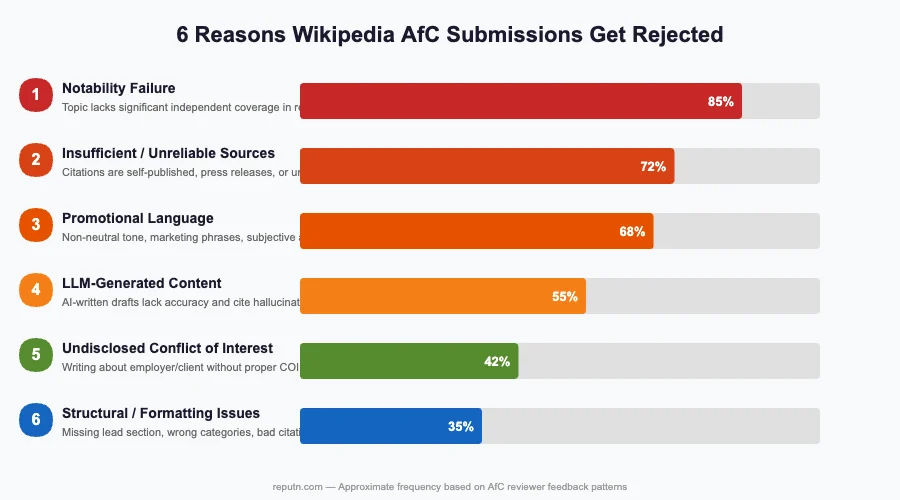
1. The Topic Doesn’t Meet Notability Guidelines
This is the single biggest reason for rejection. Not inadequate sourcing. Not promotional language. Notability.
Wikipedia’s notability standard for most topics requires “significant coverage in reliable sources that are independent of the subject.” Note that word: significant. A press release on a company’s own website doesn’t count. A quote in a trade publication roundup doesn’t count. An article about something adjacent to the subject doesn’t count.
For a business to qualify, the general rule of thumb is multiple substantial articles in mainstream or respected trade publications, written independently — not prompted by a press release, not in a “new business listings” section.
For individuals, the bar varies by category. There are specific Wikipedia notability guidelines for academics, politicians, athletes, entertainers, and business executives. Being a successful CEO doesn’t automatically qualify you. Being a well-known CEO covered by multiple major publications does.
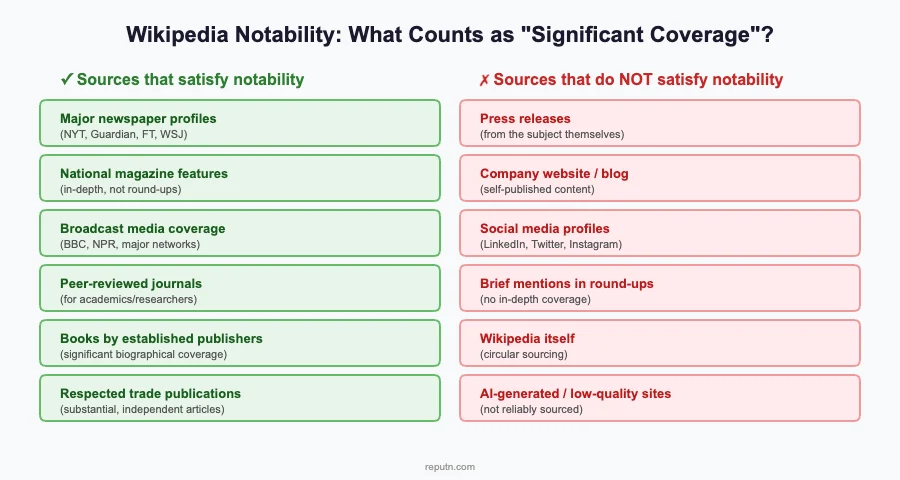
The mistake most people make: confusing the quality of their sources with the quantity of coverage. Ten brief mentions in minor publications won’t pass. Two deep-dive profiles in national media might.
2. Insufficient or Unreliable Sources
Assume your topic is notable. The second most common failure point is how you’ve sourced the article.
Wikipedia has strict rules about what counts as a reliable source. Self-published content is out. Press releases are out. Company websites are out. Social media is out. Personal blogs are out — even expert personal blogs.
What counts: major newspapers and magazines, peer-reviewed journals, books from established publishers, well-regarded trade publications, public broadcaster websites (BBC, NPR), and official government records.
What catches people off guard is that sources need to be independent and verifiable. A Wikipedia article that’s entirely sourced from the subject’s own press materials will be declined immediately. But even a well-sourced article can fail if the citations don’t actually verify the specific claims they’re attached to.
Reviewers click links. They check that the source says what you claim it says. An inline citation that goes to a general website homepage rather than a specific article is a red flag that tells a reviewer you haven’t done the work.
If you need help building a sourcing foundation before submission, Reputn’s Wikipedia page creation service handles source research and citation formatting as part of the process.
3. Promotional or Non-Neutral Language
Wikipedia’s Neutral Point of View (NPOV) policy is uncompromising. The moment your article starts reading like a company bio, a press release, or a marketing brochure, it’s flagged.
“Award-winning”, “industry-leading”, “innovative”, “pioneering”, “passionate about” — these phrases will get your draft declined faster than almost anything else. So will adjectives that imply judgment rather than report facts.
The problem is that most people writing about themselves, their company, or their client can’t help but slip into promotional language. It’s almost impossible to write objectively about something you’re invested in. This is why Wikipedia’s conflict of interest guidelines recommend that anyone with a COI hire a neutral third party to write the article.
Reviewers are trained to spot this. They’ve read thousands of articles. A promotional tone is obvious to them within a few sentences.
4. LLM-Generated Content
This one is newer but increasingly common. Wikipedia explicitly states in its AfC guidelines: “Articles that are generated entirely by LLMs will be rejected.”
The challenge is that LLM detection isn’t always accurate. But experienced reviewers don’t need a detector. They recognise the patterns: overly balanced structure, formulaic paragraph lengths, generic superlatives, the kind of smoothness that comes from a model trained to be agreeable rather than accurate.
More importantly, LLM-generated Wikipedia articles tend to hallucinate citations — inventing sources that don’t exist or misattributing claims. A reviewer who spots one fake citation will scrutinise the entire article.
The irony: using AI to write a Wikipedia article is the fastest way to guarantee rejection.
5. Conflict of Interest (COI) Problems
Wikipedia requires disclosure of paid editing and conflicts of interest. If you’re writing about your employer, your client, yourself, or a family member, you’re required to declare it.
Many people don’t. Some don’t know they need to. Others actively hide it. Wikipedia’s edit history and reviewer community are good at detecting undisclosed COI, and the consequences — article deletion and sometimes permanent account bans — are worse than if you’d disclosed from the start.
The better path: disclose the COI, submit through AfC, and let reviewers assess the article on its merits. Or better yet, work with an experienced Wikipedia editor who knows how to navigate COI disclosures without triggering red flags.
6. Structural and Formatting Issues
Reviewers aren’t just evaluating content. They’re evaluating whether the draft looks like a Wikipedia article.
Common structural problems that lead to declines:
- Missing lead section that summarises the article
- Categories added to the draft (categories are for accepted articles only)
- Headers that don’t follow Wikipedia’s conventions
- External links stuffed into the article body rather than the References section
- Inappropriate images (low resolution, missing copyright information, images that serve a promotional purpose)
These are fixable. But they signal to reviewers that the author hasn’t spent time reading existing Wikipedia articles before writing their own.
What Happens to Abandoned Drafts: The G13 Problem
Here’s something most guides completely ignore.
If you submit a draft and it gets declined, then you don’t touch it for six months, Wikipedia automatically makes it eligible for deletion under criterion G13 (CSD#G13). The draft doesn’t disappear instantly — it goes into a category of “G13 eligible soon submissions” — but it can be deleted by any administrator at any point after that.
The draft can be recovered on request. But you have to know it was deleted to know to ask.
For businesses and individuals who submitted articles months ago and never heard back, this is often what happened. The review came in, was declined, and the draft aged out.
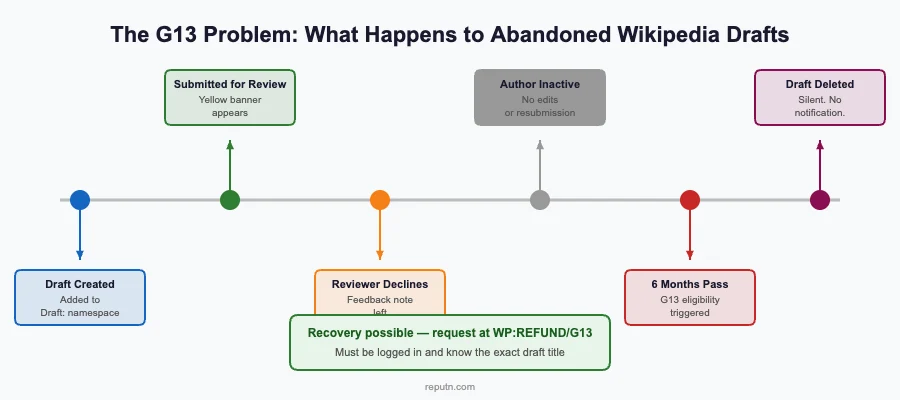
The fix: check your draft’s status regularly. If it’s been declined, read the reviewer’s notes carefully, address the specific issues raised, and resubmit. If you need support, Reputn’s team monitors and manages draft submissions through the entire process.
How to Improve a Declined Submission
A decline isn’t the end. Most declined drafts can be fixed — if you know what the reviewer was actually objecting to.
Read the decline reason carefully. AfC reviewers leave templated decline reasons, but often add specific notes. The template tells you the category of problem. The specific note tells you what, exactly, is wrong with this draft.
Fix the notability problem before sourcing. If the decline says “notability,” adding more citations won’t solve it. You need to find new, more substantial sources — or honestly assess whether the subject qualifies. Build your notability foundation before resubmitting.
Rewrite for neutrality, not accuracy. Accuracy alone won’t save a promotional draft. Every sentence needs to pass the “would this appear in a newspaper?” test. If it sounds like marketing, rewrite it.
Check every single citation. Broken links, inaccessible sources, citations that don’t support the claim — fix all of them before resubmitting. A reviewer who declined once will be looking harder the second time.
Don’t resubmit immediately. Reviewers note submission history. A draft that’s been submitted, declined, and resubmitted within days looks like the author didn’t take the feedback seriously. Wait until you’ve made substantive changes.
If you’re not confident navigating this, our guide on how to edit a Wikipedia page covers the mechanics. For the full strategy — sources, drafting, submission, and follow-through — Reputn’s Wikipedia creation service handles it end-to-end.
The Reviewer Psychology Nobody Talks About
AfC reviewers are volunteers. They’re reading dozens of submissions. They’re not being paid. They have their own standards, their own areas of expertise, and their own interpretations of Wikipedia’s guidelines.
This matters because Wikipedia’s policies are detailed, but they’re not always specific. Two reviewers reading the same article might reach different conclusions about notability. One might accept a draft that another would decline. The AfC process is supposed to be objective. In practice, there’s subjectivity.
The practical implication: a declined submission isn’t always a verdict on the article’s quality. Sometimes it reflects a specific reviewer’s interpretation. If you believe a decline was incorrect, you can take it to Wikipedia’s AfC help desk for a second opinion.
But the more useful takeaway is this: write for the most cautious reviewer you can imagine. If you’re on the fence about whether a source is strong enough, find a better one. If a sentence reads as even slightly promotional, rewrite it. Erring on the side of conservatism is always the right call on a first submission.
When to Get Professional Help
There’s a point where the effort required to get a Wikipedia article approved outweighs what most people can manage on their own.
Learning Wikipedia’s editing interface, researching citation standards, understanding notability criteria across different subject categories, managing the submission queue, responding to reviewer feedback — it’s a significant time investment. For professionals trying to establish a Wikipedia presence or companies managing executive Wikipedia profiles, the cost of getting it wrong is real.
A rejected submission creates a paper trail in Wikipedia’s edit history. Multiple rejected submissions can affect how reviewers approach future submissions. Getting banned for undisclosed COI can permanently close the door.
Reputn’s Wikipedia page creation service has published 800+ pages with a 100% approval rate. The reason isn’t luck — it’s a process built around every failure mode described in this article. Notability assessment before a word is written. Source research that meets the exact standard AfC reviewers apply. Neutral, encyclopaedic writing by editors who understand Wikipedia’s voice. Full disclosure compliance.
If you want your Wikipedia page done right the first time, that’s what we do.
FAQ
Q: How long does the AfC review process take?
The wait time varies based on the volunteer reviewer backlog — typically between 3 and 12 weeks. At particularly busy periods, waits can extend further. Submitting a well-prepared draft doesn’t speed up the queue, but it does mean the review itself is more likely to end in acceptance rather than a cycle of declines.
Q: Can I appeal a Wikipedia AfC rejection?
A formal “rejection” (as opposed to a “decline”) generally means the reviewer determined the subject is not Wikipedia-eligible at all. You can seek a second opinion at Wikipedia’s AfC Help Desk, but if the core issue is notability, no appeal changes that — you need to build the coverage first. Our guide on building Wikipedia notability explains how to approach this practically.
Q: What happens if my draft gets deleted under G13?
Your draft can be recovered by requesting restoration at WP:REFUND/G13. You’ll need to be logged in and provide the exact draft title. Once recovered, you can continue editing and resubmit. The G13 deletion is not permanent — but you have to know to ask for it.
Q: Does Wikipedia flag articles written for payment?
Yes. Wikipedia’s Terms of Use require anyone paid to contribute to disclose that relationship explicitly. Failing to disclose paid editing is a serious violation that can result in account blocks and article deletion. Working with professional Wikipedia editors who understand proper disclosure procedures is the compliant path.
Q: Why did Wikipedia accept my first article but reject my second?
Article-by-article notability is assessed independently. A subject that’s clearly notable in one context (a well-documented public figure, for example) may not carry its notability to a related but separately-assessed topic. Different reviewers can also reach different conclusions on borderline cases.
Q: Can I create a Wikipedia article about my own company?
Technically yes, but it requires full conflict of interest disclosure and subjects your submission to heightened scrutiny. The wiser approach: disclose the COI, ensure the subject genuinely meets notability standards, and use neutral, encyclopaedic language throughout. Many companies find it cleaner to engage an independent Wikipedia editor to handle the process.
The AfC process exists because Wikipedia’s standards are genuinely high. That’s not a flaw — it’s what makes a Wikipedia page worth having. The organisations and individuals who navigate it successfully tend to have two things in common: strong independent media coverage, and patience. Without the first, no amount of the second will help. With both, the process is manageable.
If you’re not sure where you stand, start with a free notability check. It’s the most honest thing anyone can tell you before you invest time in a draft.