
Reddit Defamation: Can You Remove It?
September 3, 2026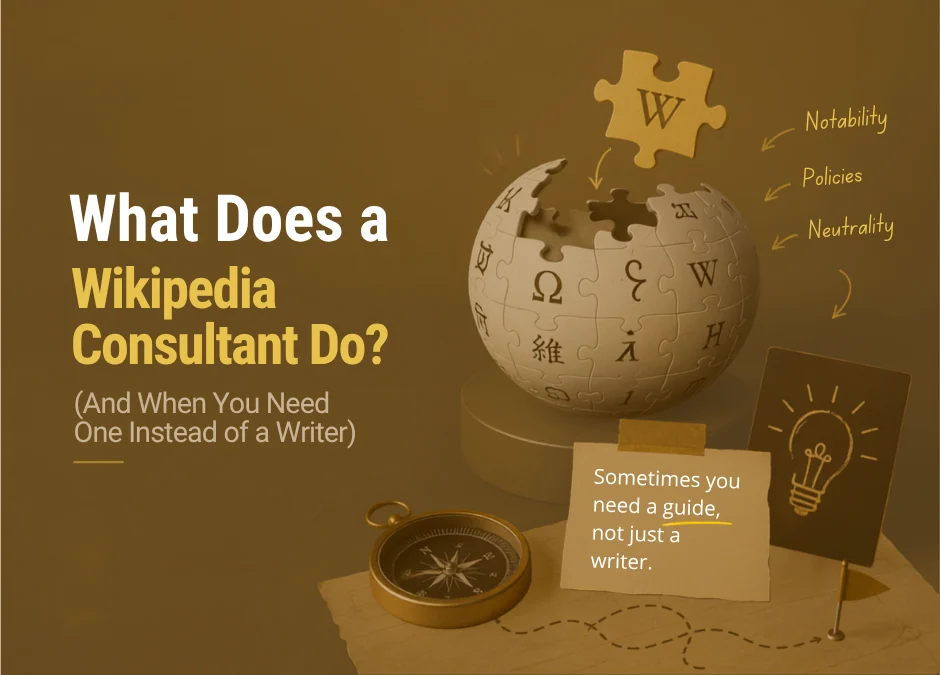
Most people who contact a Wikipedia agency think they need someone to write a page. A surprising number of them actually need advice instead, and the advice costs less than the mistake they were about to make.
That is the consultant’s job. Before anyone drafts or edits, a Wikipedia consultant tells you what is realistic, what is premature, and what’s about to blow up, before anyone touches the encyclopedia.
The title gets thrown around loosely, so let’s define the work.
What a Wikipedia Consultant Actually Does
What does a Wikipedia consultant do?
A Wikipedia consultant evaluates whether a subject qualifies for a page, builds the coverage strategy when it doesn’t, audits risks on existing pages, and guides organizations through Wikipedia’s conflict-of-interest procedures. Consultants advise; they typically don’t edit articles for you.
That advisory boundary is the defining feature, and it’s what separates consulting from the writer-for-hire market. The consultant’s product is judgment. Five kinds of it, mostly.
1. The Notability assessment
The single most valuable hour in this industry. A consultant reads your press coverage against Wikipedia’s actual standards (the general test plus the category rules for people, companies, academics, and executives) and tells you: yes, not yet, or never. Delivered honestly, this verdict saves clients four-figure writing fees on pages that would die in review, and it’s why any legitimate creation service begins with it.
2. The Coverage Roadmap
When the verdict is “not yet,” the consultant maps the gap: what kind of coverage Wikipedia counts, which publications in your industry produce it, and what’s realistically earnable in 6–18 months. This overlaps with digital PR, deliberately. Notability gets built in the press, and only recorded on Wikipedia.
3. The Risk Audit on Existing Pages
You have a page; something’s wrong with it. Outdated facts, a controversy section that’s grown out of proportion, an editor who reverts every correction. The consultant reads the article’s edit history and talk page like a chart, identifies which changes are winnable under policy, and prescribes the compliant route (usually talk page edit requests) rather than the catastrophic one (your marketing intern editing directly). The Arabella Advisors episode is the canonical example of what the catastrophic route produces.
4. Crisis Navigation
Your page just got an “undisclosed paid editing” banner. A journalist noticed edits from your corporate IP range. A deletion discussion opened on your founder’s biography. These are procedural emergencies with correct and incorrect responses, and the window for the correct one is short. Consultants who’ve watched dozens of these know which arguments carry weight in a deletion discussion and which ones make it worse.
5. Policy Training
For PR teams and agencies that touch Wikipedia regularly, a consultant teaches the rules once: COI disclosure, edit requests, what the Terms of Use require of paid contributions. Cheaper than learning by public failure.
Consultant vs. Writer vs. Editor: The Decision
The market blurs these roles; your invoice shouldn’t.
Hire a consultant when the question is whether or how: Is my CEO notable? Why does our page keep reverting? Is this deletion nomination survivable? What would it take to qualify in two years?
Hire a writer when the answer to “whether” is already yes and the job is execution: research, drafting, disclosure, and shepherding the draft through Articles for Creation. That full workflow is covered in our page creation guide.
Hire an editor when a live page needs compliant maintenance: corrections, updates, vandalism response.
The sequence matters more than the titles. Consulting comes first because everything downstream is wasted if the verdict is wrong. Paying for a beautifully written draft about a non-notable subject is the most common four-figure error in this industry, and it’s fully preventable with one assessment. The cost structure across all three services reflects that logic.
Plenty of firms, ours included, bundle the roles: assessment first, then writing only if the subject clears the bar. What you’re avoiding is the seller who skips the assessment, and we’ve written about what that skip signals.
What Wikipedia Consulting Costs
Hourly rates for genuine specialists run $150–$500, with most engagement types falling into predictable ranges.
A standalone notability assessment runs free to a few hundred dollars depending on subject complexity. (Reputn’s is free; we treat it as the intake step.)
A page risk audit with a written remediation plan typically lands at $500–$2,500.
Crisis engagements (deletion discussions, paid-editing investigations, press attention on your edit history) are scoped case by case, and speed costs money for the same reason it does in law.
Retainer advisory for organizations with ongoing exposure runs a few hundred to a few thousand monthly, often paired with page monitoring.
Compare those numbers against the failure they prevent. A deleted page plus a public sockpuppetry log plus a stricter review on every future attempt costs more to unwind than a decade of assessments.
One Thing a Good Consultant Will Tell You That You Don’t Want to Hear
Sometimes the right Wikipedia strategy is no Wikipedia page.
A page is permanent, publicly editable, and bound to reflect whatever reliable sources publish about you next. For a subject with thin coverage and a complicated history, a page is a liability that invites consolidation of every negative story into one top-ranked document. Consultants who’ve seen that movie recommend against pages more often than sellers would ever admit, and they’ll usually point borderline clients toward the coverage-building phase instead, or toward assets you control more directly, like a Google Knowledge Panel.
If every consultant you talk to says yes, you haven’t talked to a consultant yet. You’ve talked to salespeople.
FAQ
Q: Is hiring a Wikipedia consultant allowed under Wikipedia’s rules?
Yes. Advice, strategy, and training involve no on-wiki editing, so most consulting doesn’t even trigger disclosure rules. The moment a consultant edits or writes for pay, standard paid-contribution disclosure applies to them like anyone else.
Q: Why hire a consultant instead of just asking on Wikipedia’s help forums?
The Teahouse and help desks are real and free, and volunteers there are often excellent. What they won’t do is study your specific press portfolio for an hour, audit your page’s edit-war history, or design an 18-month coverage strategy. Free help answers questions; consulting answers your situation.
Q: Can a consultant get negative information removed from our page?
Not if reliable sources support it, and anyone who promises otherwise is selling the Arabella playbook. What a consultant can do: identify material that genuinely violates policy (poor sourcing, undue weight, BLP violations) and pursue its correction through legitimate channels, which succeeds far more often than brute force.
Q: Our agency manages client reputations. Do we need ongoing consulting or one training?
One structured training plus an on-call arrangement covers most agencies. The training prevents the routine errors; the on-call handles the genuine emergencies, which are rarer but unforgiving of improvisation.
Q: How do I verify a consultant actually knows Wikipedia?
Ask what they’d do with a borderline subject, and listen for “wait and build coverage” (right answer) versus “we have techniques” (wrong one). Ask them to explain the difference between a decline and a rejection at AfC, or what G13 does to abandoned drafts. Fluency in the boring procedure is the credential; the platform has no official certification.
The consultant’s whole value is delivered before anything happens on Wikipedia: the accurate verdict, the realistic timeline, the disaster that didn’t occur. If you’re weighing a page for yourself, your executive, or your company, start with the verdict. Reputn’s notability assessment is free, and it comes with the one thing this industry undersupplies: a straight answer.